Are you in Class 10th or an ITI student wondering how to secure a stable, high-paying government job without drowning in student debt? The traditional path to success is often long, expensive, and leaves graduates with massive loans. But what if there was a smarter, faster way to achieve financial independence and a coveted government career by the time you’re just 20 years old?
Meet Ravi, Sruthi, and Shankar – three ambitious individuals who hacked the system. They didn’t just get jobs; they forged an “AI-Ready Hybrid Technician Model” that propelled them into respected government roles while their peers were still in costly college classrooms.
This isn’t just a career plan; it’s an unstoppable success formula for the digital age!
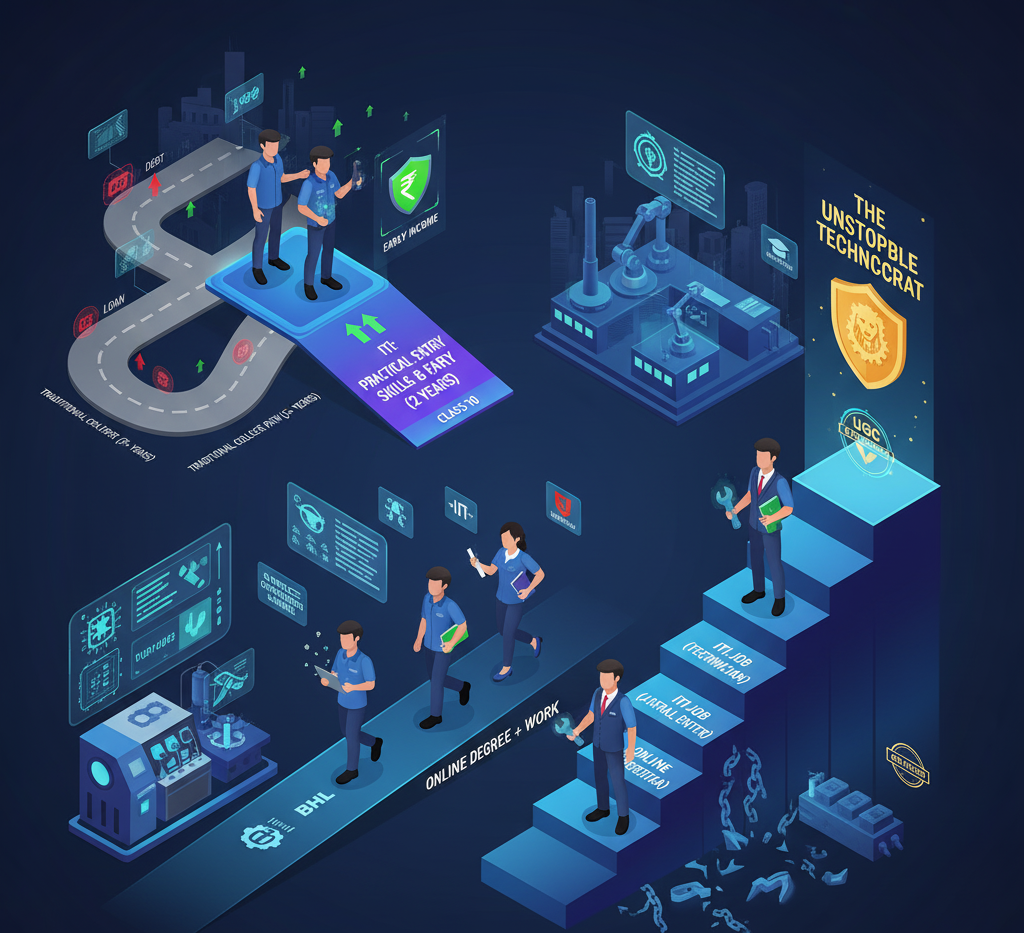
Visualize Your Future: The ITI to Government Job Success Ladder
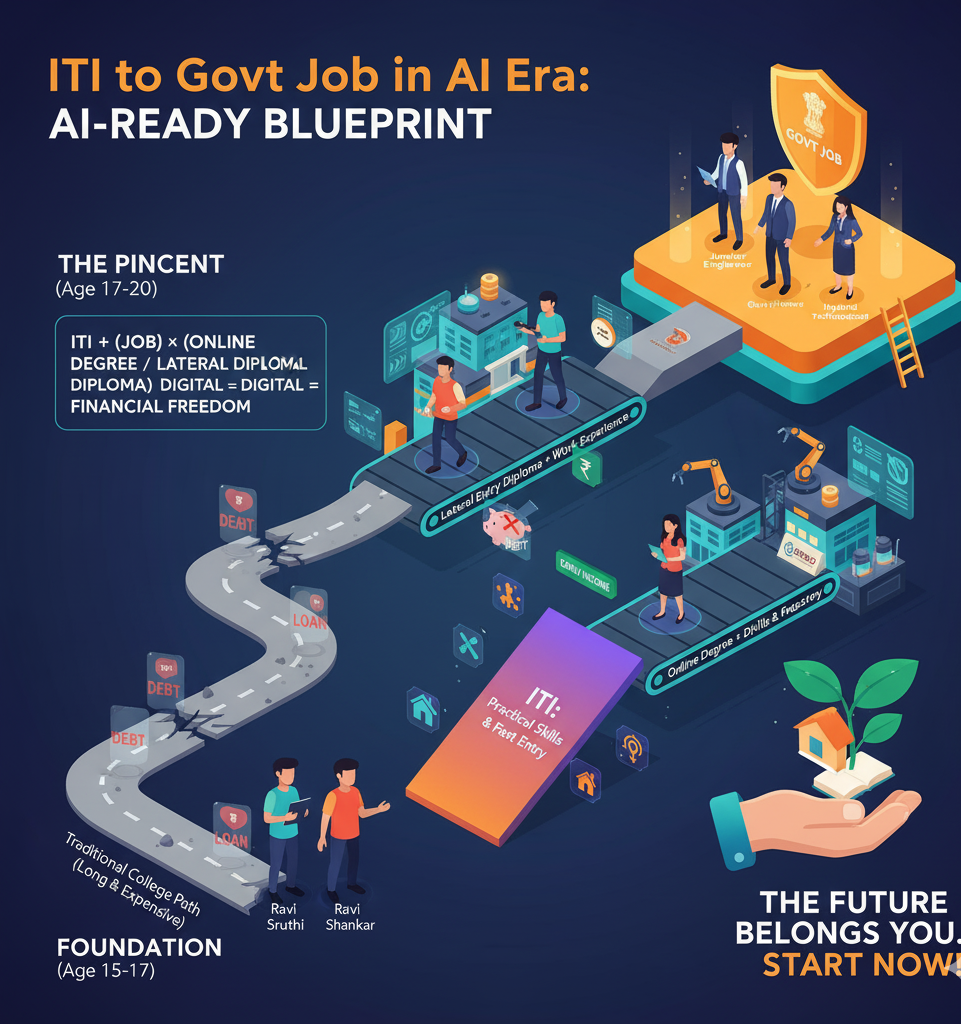
To truly grasp the genius of their strategy, let’s visualize their journey. Our dynamic 3D infographic perfectly illustrates their accelerated path to success:
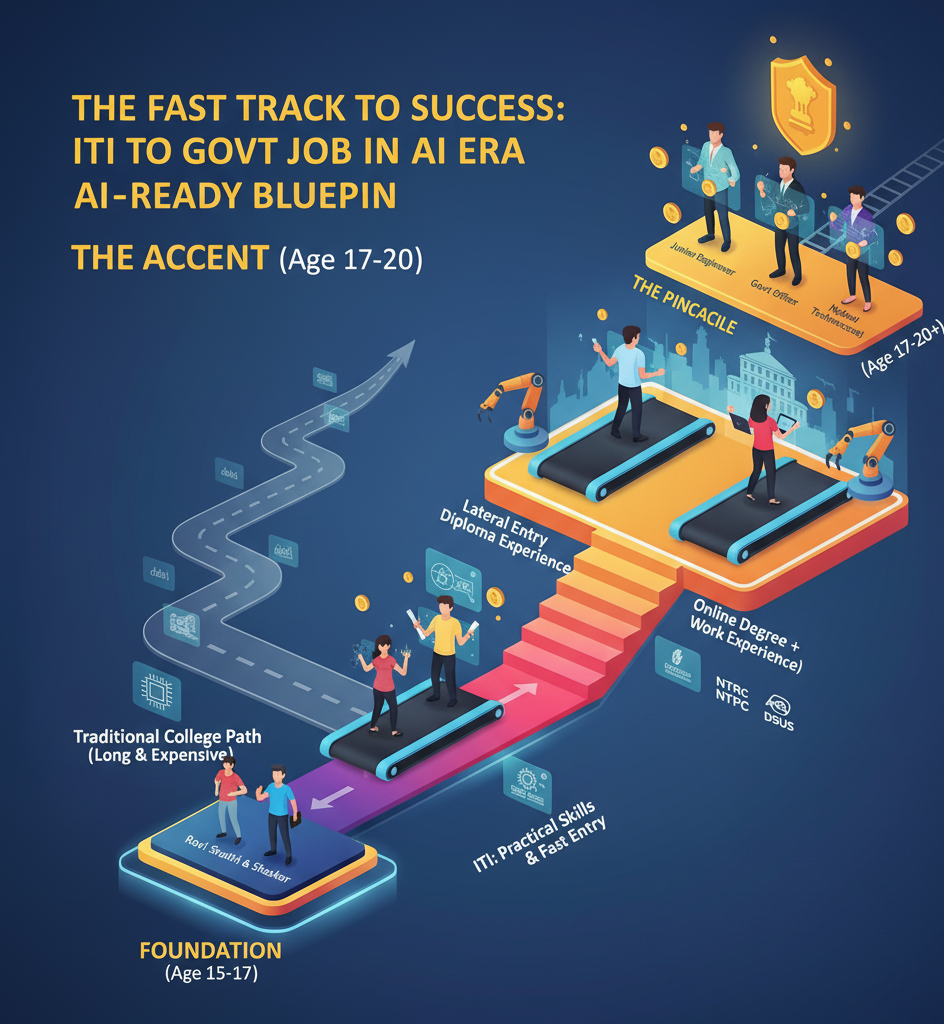
Let’s break down this powerful visual step-by-step:
1. The Tactical Launchpad (Foundation: Age 15-17)
At the very base of our success ladder, we see Ravi, Sruthi, and Shankar after their Class 10th exams. While one long, winding path labeled “Traditional College Path (Long & Expensive)” stretches out, adorned with transparent “debt” icons, our trio chose a different route.
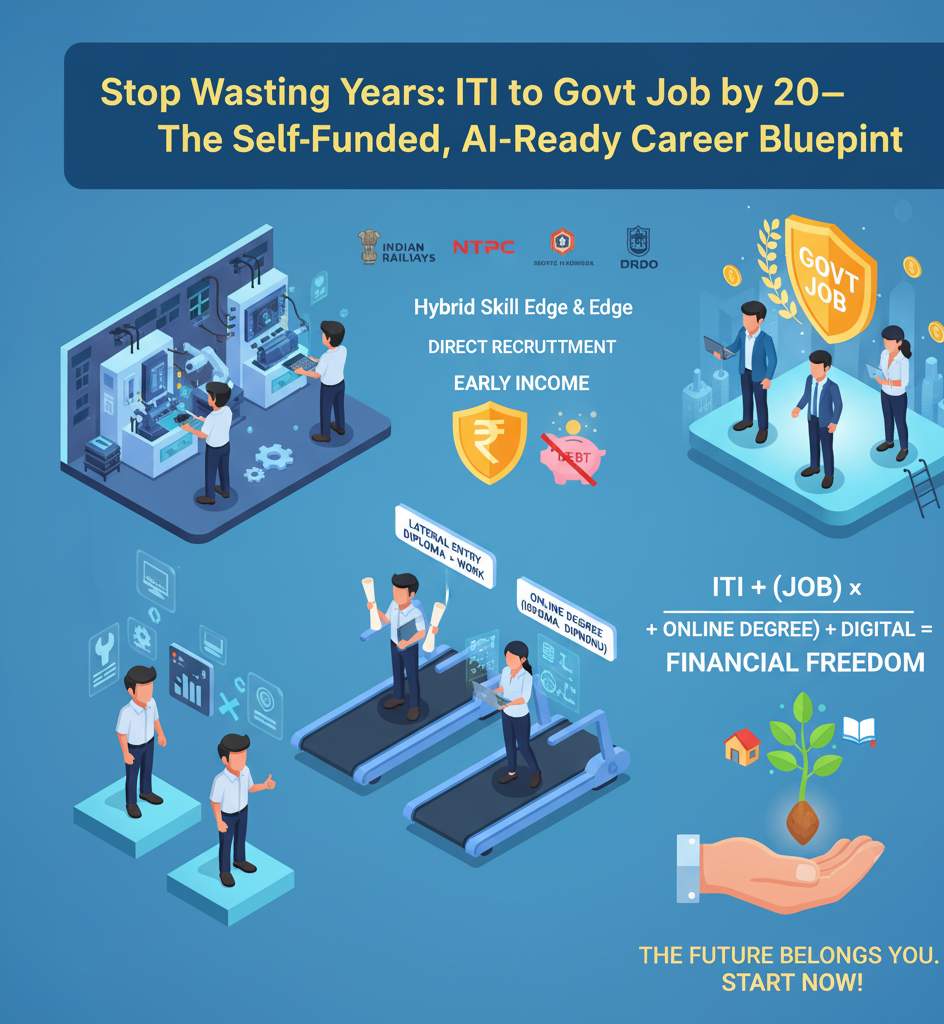
Their decision? The “ITI: Practical Skills & Fast Entry” path—a steep, direct, and efficient ramp upwards.
- Smart Trade Selection: They didn’t just learn a skill; they strategically chose trades like Fitter, Electrician, and Electronics Mechanic. These are AI-resistant and essential for modern infrastructure, focusing on complex installation, diagnostics, and hands-on maintenance that automation cannot fully replicate.
- The Hybrid Skill Edge: They understood that AI empowers, not replaces, the expert technician. While in ITI, they proactively acquired crucial digital upskilling in areas like Digital Documentation, Sensor Data Interpretation, and Basic Automation Logic. This made their core ITI skills future-proof and highly valuable.
- Zero Parental Burden: By age 17-18, armed with their ITI certification and sharp digital literacy, they secured entry-level roles as Technicians, Maintainers, or Technical Attendants in India’s leading public sector enterprises: Indian Railways, NTPC, BHEL, DRDO, ISRO, and other PSUs. Their initial “little salary” (often covering ₹15,000-₹25,000/month) allowed them to cover their living costs and tuition fees, instantly removing any financial burden from their parents.
Public & Government Sector Institutions Offering Entry-Level ITI Jobs:
| Sector | Key Institutions/Companies (PSUs) | Typical Entry-Level Post | ITI Trades in Demand |
| Railways | Indian Railways (RRB, RPF) & Metro Rail Corporations (DMRC, LMRC) | Assistant Loco Pilot (ALP), Technician, Maintainer | Fitter, Electrician, Mechanic Diesel, Electronics Mechanic, Welder |
| Power/Energy | NTPC, PGCIL, State Electricity Boards | Technician, Attendant, Junior Lineman | Electrician, Wireman, Fitter, Instrument Mechanic |
| Manufacturing/Heavy | SAIL, BHEL, HAL | Technician, Operator-cum-Technician | Fitter, Machinist, Turner, Welder |
| Defence/Research | DRDO, ISRO, BARC | Technician ‘B’, Trade Apprentice, Tradesman | Fitter, Electrician, Electronics Mechanic |
| Oil & Gas/Chemical | ONGC, IOCL, GAIL, HPCL | Technical Attendant, Junior Assistant (Technical) | Fitter, Electrician, Instrument M |
2. The Double-Degree Power Play (The Ascent & Pinnacle: Age 17-20+)
This is where their strategy truly shines. Already earning and gaining invaluable experience, Ravi, Sruthi, and Shankar turned their workplaces into extended classrooms, self-funding their climb up the academic and professional ladder.
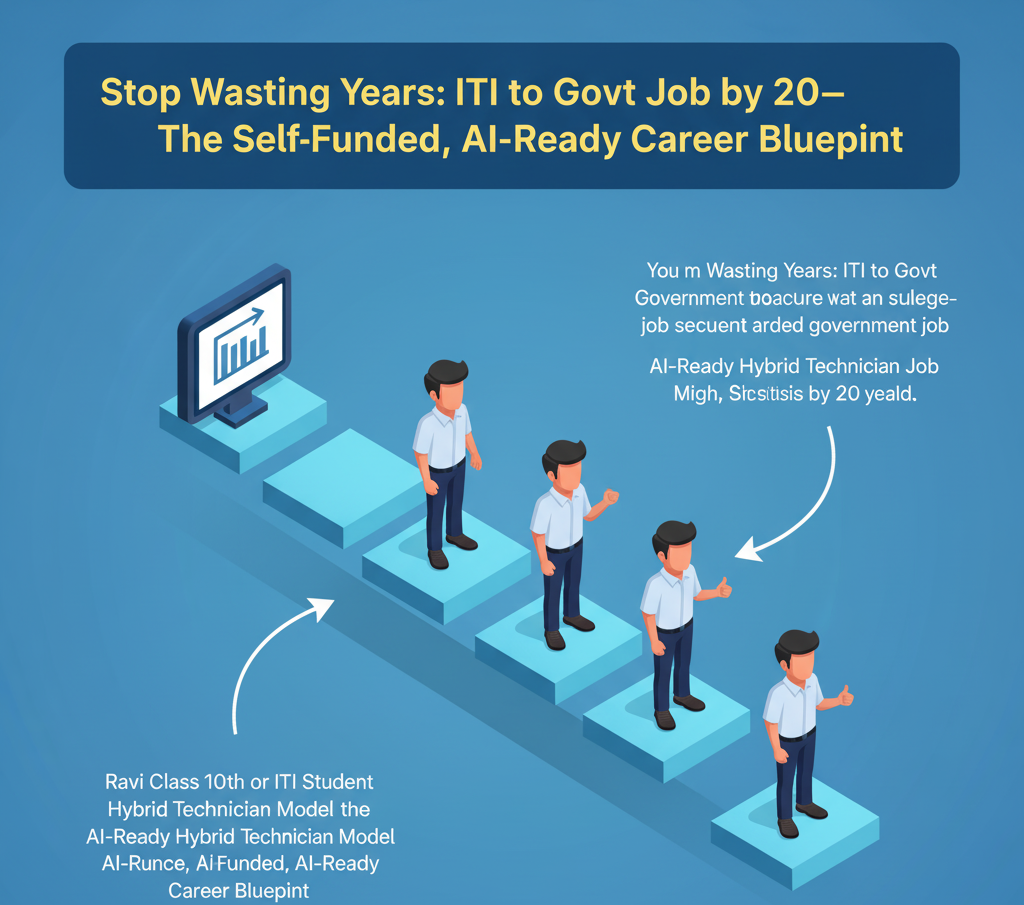
On our visual, we see them on parallel “treadmills” moving upwards, symbolizing their simultaneous work and study.
- Ravi & Shankar’s Strategy (The Technical Climb): They leveraged the powerful ITI to Diploma Lateral Entry Scheme, allowing them to skip the first year of a 3-year Diploma course (e.g., Mechanical or Electrical Engineering). Working and studying simultaneously, they were primed to pass Diploma-level Government Exams (like SSC-JE, RRB-JE) or Internal Departmental Promotional Exams much earlier. Their upskilling focused on CAD/CAM, Predictive Maintenance software, and diagnostic AI tools for their daily tasks.
- Sruthi’s Strategy (The Degree Ace): Sruthi opted for a UGC-recognised online degree (e.g., B.A./B.Com) from IGNOU. The online format was critical: no costly campus fees, no rigid class schedules. This degree future-proofed her for later administrative, supervisory, and even officer-level promotions, while her digital upskilling focused on Data Analysis and Cybersecurity awareness relevant to critical infrastructure.
The Earliest Promotion Path: Job, Degree, Experience, and Supervisory Role
This strategic combination leads to the fastest promotion:
- Entry-Level Job (Age 17-18): ITI Certificate → Technician/Maintainer in PSU/Railways.
- Promotional Qualification (Age 19-20): Engineering Diploma (via Lateral Entry while working).
- Earliest Promotion (Age 20-22): Appear for Departmental Promotional Exams (DPEs) or Junior Engineer (JE) exams (SSC-JE, RRB-JE).
- Result: Promotion to Junior Engineer (JE), Supervisor, or Foreman (Group ‘B’ or equivalent supervisory grade) by age 21-22, securing a significant salary jump and increased authority.
The Pinnacle of Success (Age 20+):
At the very top of our visual, by their early 20s, Ravi, Sruthi, and Shankar stand tall and confident. They are no longer just ITI graduates but certified Junior Engineers, Government Officers, and Hybrid Technocrats—possessing the trifecta of a stable job, critical experience, and advanced qualifications.
Top 10 FAQs for Your Accelerated ITI Career Path
For those inspired to follow this blueprint, here are the answers to the most common, thought-provoking questions:
- Is an ITI certificate valid for direct government recruitment?
- A: Absolutely. Major organizations like the Indian Railways, DRDO, ISRO, and all PSUs regularly conduct direct recruitment for positions like Technician, Assistant Loco Pilot (ALP), and Tradesman based purely on ITI qualifications.
- Which ITI trades are best for future-proofing against AI/Automation?
- A: Trades focused on installation, complex fault diagnosis, system integration, and repair, such as Electrician, Fitter, Electronics Mechanic, and Instrument Mechanic, are highly valued. These skills require human judgment that automation cannot replace.
- Can I really get a job at age 17 or 18 after ITI?
- A: Yes. Many ITI courses are two years long, making you eligible for recruitment around age 17-18. Furthermore, the Apprenticeship Act often mandates companies to recruit ITI pass-outs, offering a direct path to employment.
- How do I pay for the Diploma or Degree while earning a “little salary?”
- A: The ITI starting salary, while modest, is sufficient to cover the low fees of IGNOU’s online degree courses or Polytechnic Diploma fees (Lateral Entry), especially through part-time or distance modes. You are funding your education, not your parents.
- Is an IGNOU online degree truly equal to a regular degree for a government job?
- A: Yes. Degrees awarded by IGNOU, being a Central University established by an Act of Parliament and recognized by the UGC, are treated as equivalent to degrees from any other recognized university for government job eligibility and higher studies.
- What is the “Lateral Entry Scheme” after ITI?
- A: It allows an ITI pass-out to gain direct entry into the second year of a 3-year Diploma in Engineering (Polytechnic), cutting the total time needed for the Diploma from three years to just two.
- What is the ultimate career jump from ITI?
- A: The biggest jump is from a Technician role (ITI-based) to a Junior Engineer (JE) or Supervisor role (Diploma-based). This jump is often facilitated by internal departmental exams that favor experienced employees with higher qualifications.
- How much does “digital upskilling” matter for a technician?
- A: It’s vital. Modern machines are connected (IoT). A hybrid technician who can fix a machine (ITI skill) and analyze its performance data (Digital skill) using a simple software tool is far more valuable and promotable than a technician who only knows how to fix it.
- Are there age limits for this path?
- A: Most ITI-level entry jobs have an upper age limit around 25-30 years (with relaxation for reserved categories). Starting early at 17-18 gives you multiple attempts for direct recruitment and plenty of time to earn a Diploma/Degree before the upper limit.
- Is this path secure, or should I still aim for a B.Tech?
- A: This path is incredibly secure because it offers job stability first (ITI job in PSU/Railways) and academics second (Diploma/Degree while working). A B.Tech is a four-year investment that guarantees neither job nor experience; this path guarantees both income and growth, making it a highly practical choice for early career success.
Thought-Provoking Conclusion: The Future Belongs to the Hybrid Technocrat
The era of “all talk, no tools” is over. The future of the Indian workforce, especially in the stable and growing government sector, belongs to the Hybrid Technocrat—the individual who can master both the wrench and the code.
Ravi, Sruthi, and Shankar didn’t just chase a certificate; they chased strategic independence. They proved that the highest quality education is the one that is paid for by your own hard work, not by your parents’ savings.
Think about it: at a time when graduates are struggling under the weight of education loan debt, our trio had already bought their freedom. They transformed their ITI training from a final qualification into a powerful Launchpad.
Your hands-on skill is your greatest asset. Your ability to self-educate (via IGNOU or Lateral Entry) is your superpower. By combining the two, you don’t just secure a government job by 20; you become the unstoppable, self-made asset that no amount of automation or economic turbulence can ever replace. The future is waiting. Start building it with your own hands, today.
Further Resources:
To explore upcoming opportunities relevant to ITI holders in the public sector, watch this informative video: ITI Upcoming Recruitment 2025 DRDO, BARC, IOCL, SAIL, DMRC, ISRO, BHEL, Coal India, Recruitment |